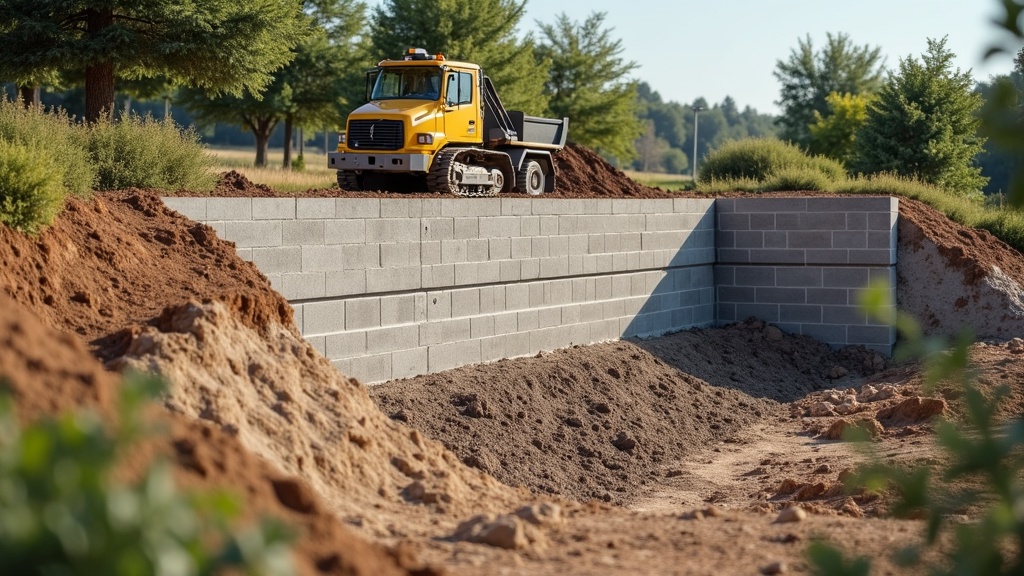
Learn proper retaining wall backfill techniques to ensure structural stability and effective drainage. Discover material selection, compaction methods, and industry best practices for constructing durable retaining walls that last.
Table of Contents
- Overview of Retaining Wall Backfill
- Backfill Material Selection
- Compaction Methods and Lift Thickness
- Drainage Integration
- Frequently Asked Questions
- Comparison of Backfill Approaches
- Practical Tips
Retaining wall backfill is the critical process of placing suitable material behind a retaining wall to provide drainage and lateral support. Proper compaction and material choice prevent wall failure and ensure longevity. This guide covers material selection, compaction techniques, and drainage integration for durable walls.
By the Numbers
- Recommended backfill lift thickness: 300 mm layers (Retaining Wall Solutions, 2024)[1]
- Granular drainage zone width: at least 12 inches behind the wall (Landscaping Network, 2024)[2]
- Gravel backfill depth behind blocks: 12 inches (Allan Block, 2024)[3]
- Compaction target: 95% of maximum dry density (Geospec / GCO, 1989)[4]
Retaining wall backfill is one of the most overlooked aspects of wall construction, yet it directly determines the wall’s ability to withstand lateral earth pressures and prevent water buildup. Poor backfill can lead to bulging, cracking, or complete wall failure. This article explores the essential elements of retaining wall backfill, from material selection to compaction best practices, and provides actionable guidance for builders and homeowners alike.
Overview of Retaining Wall Backfill
The term retaining wall backfill refers to the material placed in the excavated area behind a finished retaining wall. Its primary purpose is to facilitate drainage and reduce hydrostatic pressure, while also providing lateral support. Without proper backfill, water can accumulate behind the wall, increasing pressure and causing structural damage. Choosing the right material and achieving adequate compaction are non-negotiable steps for any retaining wall project.
In many regions, local building codes specify minimum requirements for backfill materials and compaction. Engineers often recommend granular materials such as crushed stone or gravel because they drain well and resist settlement. The backfill must be placed in lifts and compacted methodically to avoid future settlement that could compromise the wall’s alignment.
Backfill Material Selection
The choice of backfill material for your retaining wall significantly impacts performance. Ideally, the backfill should be free-draining, non-cohesive, and chemically inert. Common options include crushed stone, gravel, and sand. The particle size matters: one guide recommends clean coarse gravel with a diameter of 3/4 to 1 inch (Aspire Consulting Group, 2024)[5] for optimal drainage and compaction. Avoiding clay or silt-laden soils is critical, as these retain water and generate excessive pressure.
In specialized applications such as mining and large-scale civil engineering, backfill grouting techniques are used to stabilize voids and improve load transfer. The target domain backfill grouting training resources offer advanced methods for cementitious backfill, though for standard retaining walls, coarse granular fill remains the standard. Geotextile fabrics may be placed between the backfill and native soil to prevent migration of fines and maintain drainage capacity.
Granular vs. Soil Backfill
Granular backfill (gravel, crushed stone) is preferred for drainage and compaction ease. Soil backfill is sometimes used for economy but must be compacted to very high standards and is more prone to water retention. For most retaining walls, at least 12 inches of granular backfill directly behind the wall is recommended (Landscaping Network, 2024)[2]. This zone acts as a drainage blanket, directing water to weep holes or a perforated pipe.
Compaction Methods and Lift Thickness
Compaction is the process of increasing the density of backfill material to reduce future settlement and increase shear strength. Proper compaction prevents the backfill from settling over time, which can cause the wall to lean or crack. The backfill should be placed in thin lifts and compacted mechanically. According to design guidance, backfill material should be placed in 300 mm layers and consolidated using a vibrating plate over drainage fill and a roller over main soil fill (Retaining Wall Solutions, 2024)[1].
Compaction effort must match the material type. For granular materials, vibration is highly effective. For cohesive soils, impact compaction may be needed. The degree of compaction specified is often at least 95% of the maximum dry density (Geospec / GCO, 1989)[4]. Achieving this requires moisture control and careful testing. Over-compacting can damage the wall; under-compacting leaves voids.
A practical rule from installation guides states that the backfill should progress one wall block behind the wall construction (HowToHardscape, 2024)[6]. This means you should not backfill more than one block height ahead of the wall’s current course, preventing uneven pressure that could displace blocks.
Drainage Integration
Effective drainage is a cornerstone of successful retaining wall backfill. Even with granular fill, water can accumulate if no drainage pathway exists. Weep holes, perforated pipes, and gravel drainage blankets work together to channel water out from behind the wall. A perforated drainage pipe should be placed at the base of the wall, sloped at least 1/8 inch per foot (HowToHardscape, 2024)[6], to carry water to an outlet.
As noted by Allan Block, you should “fill the cores of the block and at least 12-inches behind the block with wall rock”[3]. This wall rock zone provides immediate drainage and prevents clogging of weep holes. Geotextile fabric over the backfill prevents soil from washing into the gravel layer. Combining proper backfill material with a well-designed drainage system ensures the wall remains stable for decades.
What People Are Asking
What is the best material for retaining wall backfill?
The best material is clean, coarse granular fill such as crushed stone or gravel, typically 3/4 to 1 inch in diameter. This material drains well, compacts easily, and does not retain water. Avoid clay, silt, or organic soils.
How thick should backfill lifts be when compacting?
Lifts should be no thicker than 300 mm (about 12 inches) before compaction. Thicker lifts prevent achieving uniform density and can lead to differential settlement. Use a vibrating plate for granular materials and a roller for soil fills.
Do I need a drainage pipe behind a retaining wall?
In most cases yes. A perforated pipe at the base of the wall, wrapped in geotextile and surrounded by gravel, carries water away and prevents pressure buildup. The pipe should slope at least 1/8 inch per foot toward an outlet.
Can I use soil from my yard as backfill?
It is not recommended. Native soil often contains clay and organic matter that retain water and are difficult to compact uniformly. For a stable wall, use imported granular fill at least 12 inches behind the wall and compact in lifts.
Comparison of Backfill Approaches
Different retaining wall projects may call for different backfill strategies. The following table compares three common approaches for residential and commercial walls.
| Approach | Material | Drainage | Compaction Requirement | Best For |
|---|---|---|---|---|
| Full Granular Backfill | 3/4–1 inch crushed stone | Excellent natural drainage | 95% relative density, lifts ≤12 in | Tall walls, poorly draining soils |
| Hybrid: Granular Zone + Soil | Granular 12 in behind wall, then soil | Good if granular zone is properly drained | Granular compacted in lifts; soil to 95% | Moderate walls, cost savings |
| Full Soil Backfill | Imported sandy gravel or clean soil | Requires subsurface drainage pipe | High compaction, moisture control | Low walls, competent native soil |
Each approach requires careful attention to lift thickness, compaction equipment, and drainage integration. The hybrid method is commonly used in residential projects where budget constraints exist. The full granular method is the most reliable and is recommended by most manufacturers.
Practical Tips
Follow these actionable tips to ensure your retaining wall backfill project succeeds. First, always refer to the wall manufacturer’s specifications. For modular block walls, observe the rule of backfilling only one block height ahead. Second, test the compaction density using a nuclear gauge or sand cone test to verify 95% of maximum dry density. Third, use geotextile fabric to separate the drainage gravel from native soil. Fourth, ensure the drainage pipe outlet is clear and sloped properly. Fifth, consider the long-term vegetation near the wall – root growth can affect backfill stability. For related landscaping tips, see our creeping hemlock guide for maintaining ground cover around structures.
For advanced backfill applications in mining and heavy civil works, specialized engineering is required. Backfill grouting techniques involve pumping cementitious slurries to fill voids and stabilize ground. To learn more about these industrial methods, explore the backfill grouting training courses available for professionals. Even for standard retaining walls, understanding these principles deepens your ability to design effective drainage and compaction plans.
Wrapping Up
Mastering retaining wall backfill is essential for any wall that must last. From selecting clean granular material to compacting in 300 mm lifts and installing effective drainage, every step contributes to long-term stability. Whether you are a contractor or a DIY homeowner, following these best practices will save time and prevent costly repairs. For further guidance on landscape construction, check out our creeping hemlock guide for plant-friendly wall maintenance.
Further Reading
- Backfilling a Retaining Wall. Retaining Wall Solutions.
https://retainingwallsolutions.co.uk/design/backfilling-a-retaining-wall/ - Retaining Wall Drainage & Backfill Basics. Landscaping Network.
https://www.landscapingnetwork.com/walls/retaining.html - How to Properly Backfill and Compact Retaining Walls using Allan Block. Allan Block.
https://www.youtube.com/watch?v=7UpukRBzm8E - eg1 chapter 3. Geospec / GCO.
https://www.scribd.com/document/703049599/eg1-chapter3 - Retaining Wall Backfill. Aspire Consulting Group.
https://aspirecg.net/backfill/retaining-wall-backfill/ - Backfilling a Retaining Wall. HowToHardscape.
https://howtohardscape.com/backfilling-a-retaining-wall/